Can AI finally help organizations understand what’s actually in their content libraries? John Leh sat down with Robert Gadd of OnPoint Digital to find out.
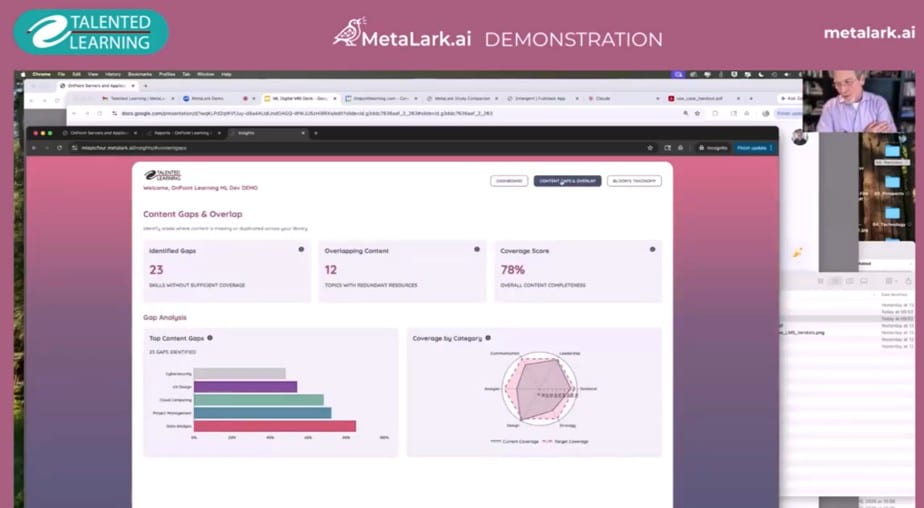
Watch the full demo on the Talented Learning Demonstration Series — click to view
Most learning and development teams have a problem they rarely talk about out loud: they have no idea what is actually in their content library. Courses built a decade ago sit untouched in the LMS. Metadata is incomplete or missing entirely. Skills tags were added inconsistently, or not at all. Videos, PDFs, SCORM packages, and infographics are scattered across cloud drives, legacy platforms, and shared folders, with no single view of what exists, what it covers, or whether any of it is still worth keeping.
This is not a new problem. But until now, there has not been a practical solution for it.
That is what made John Leh, a learning industry analyst at Talented Learning, want to take a closer look at MetaLark.ai. John has spent years helping organizations evaluate and select learning technology, and he has watched content chaos derail countless LMS migrations, skills initiatives, and AI deployments. When he heard that OnPoint Digital had built a tool designed specifically to solve this problem, he invited Robert Gadd, Founder and CEO of OnPoint Digital, onto the Talented Learning Demonstration Series to show it in action.
What followed was one of the more eye-opening product demonstrations the series has featured. Here is what MetaLark does, how it works, and why it matters.
What’s the Problem MetaLark Was Born to Solve?
MetaLark grew directly out of a real customer problem. A large enterprise client came to OnPoint Digital with two urgent challenges.
The first was a skills initiative. The organization had committed to becoming a skills-driven company. They had Workday Skills Cloud in place and had hired a specialist vendor to help build out their skills framework. But when they looked at their learning content, they discovered that most of it had no skills alignment whatsoever. The metadata was incomplete, the tags were wrong or missing, and there was no way to know which courses actually taught which skills. You cannot build a skills-based organization when your content library is a black box.
The second challenge was regulatory. As part of a major business transaction, the company needed to find every instance where specific language appeared across their entire content portfolio. That language, acceptable under a previous administration, was no longer permitted. It could be buried anywhere: inside a SCORM course, embedded in a PDF, even printed on a T-shirt in a stock photo inside a slide. They needed to find it all, catalog it, and build a remediation plan. And they had no idea where to start.
OnPoint Digital built a solution for that client. Then they realized the problem was universal, and MetaLark was born.
What is Metalark?
MetaLark is a content intelligence toolkit. Robert Gadd describes it as a digital MRI for learning content. Rather than generating new content with AI, it goes in the opposite direction: it analyzes existing content, breaks it down to its component parts, and uses a combination of machine learning and targeted AI to produce a complete, structured picture of what an organization actually has.
This is a meaningful distinction. Most AI tools in the learning space are generative. They take a prompt and produce something new. MetaLark takes what already exists and makes sense of it. Because it operates entirely on an organization’s own content in a private instance, it does not hallucinate. There is no risk of the system inventing information, because it is only ever working with what is actually there.
The 25 years of enterprise LMS experience behind the OnPoint Digital team is what makes this possible. The machine learning models that drive MetaLark were built by people who understand the difference between a Storyline course published today and one published a decade ago, who know how to read a SCORM manifest, and who can spider through a zip package and make sense of every component inside it. This is not something a general-purpose LLM can do. It required years of specialized knowledge to build.
How Does It Work? The Four Steps
MetaLark moves content through four stages.
1. Ingestion
Content comes into MetaLark from wherever it lives. That means SCORM packages, xAPI courses, videos, audio files, PDFs, Word documents, PowerPoint files, HTML pages, images, and infographics. It also means connecting directly to cloud drives like SharePoint or Google Drive, or pulling from an LMS via API. Organizations can watch a folder and have new content processed automatically, or simply drag and drop files in. Everything is ingested in its original format.
2. Deconstruction and Analysis
This is where the real work happens. MetaLark unpacks each piece of content and analyzes it at a granular level. For a SCORM course, that means reading the manifest, identifying the authoring tool and version, and working through every component in the package. For a video, it means transcription and timestamp-level indexing. For an image embedded inside a PDF, it means running image recognition to identify logos, text, and visual elements.
The system generates a title and description if none exists, identifies the skills reflected in the content, applies metadata tags (both from a customer-defined taxonomy and from AI-generated suggestions), produces a plain-language summary, and creates text, Markdown, and JSON versions of the content for downstream use. Every piece of content gets vectorized so it can be searched semantically.
3. Review and Decision
Once content is analyzed, teams can review it and assign each item one of four statuses. Retain means the content is current and should stay. Refresh means it needs to be updated, whether that is replacing outdated branding, correcting factual information, or bringing the format up to date. Retire means the content is redundant, obsolete, or simply no longer worth keeping. Reuse means the content is structurally sound and ready to be migrated to a new platform or repurposed elsewhere. The system keeps a full audit trail of every decision and who made it.
4. Action and Export
After decisions are made, MetaLark helps act on them. Content marked for migration can be staged and exported in the format required by a target LMS. Skills data can be pushed to a skills platform. Vetted content can be packaged and fed into an LLM or agentic system. Artifacts from an older authoring tool, such as a Captivate course, can be exported in a format that can be imported into a modern tool as a starting point for rebuilding. Everything moves through APIs, so the process can be as automated as the organization wants it to be.
What’s the Search Capability? Finding the Needle in the Haystack
One of the most striking parts of the demonstration was watching MetaLark’s search functionality in action. Because all content is vectorized and analyzed at a granular level, including the text inside images, the narration inside videos, and the visual elements inside SCORM packages, the search goes far deeper than anything a standard LMS can offer.
Robert Gadd demonstrated searching for a product name and finding it in a PDF, then finding the same product’s logo inside an image embedded within a different PDF. He searched for the word “cyber” and surfaced it in a SCORM course, in a second version of that course, and inside a video, with exact timestamps showing when it was spoken. Clicking any result launched the content player and jumped directly to that moment.
The most memorable example: searching for the word “Brooks” turned up a SCORM course about managing change. The word appeared not in the text of the course but on the shorts of a person in a photograph. MetaLark had read the image, recognized the logo, and indexed it. That is the level of granularity the system operates at.
What Use Cases Does MetaLark Address?
LMS Migration
Anyone who has managed an LMS migration knows the content problem. You have hundreds or thousands of items with incomplete metadata, unclear ownership, and uncertain quality. MetaLark gives migration teams a complete inventory with quality assessments, skills alignment data, and migration-ready exports. What used to require months of manual review can be completed in a weekend.
Mergers and Acquisitions
When two organizations merge, their content libraries merge too, along with all the outdated branding, conflicting naming conventions, and duplicate courses that come with them. MetaLark can scan the combined library, identify every instance of legacy branding across all content types including text, images, and embedded graphics, and produce a prioritized refresh plan. For an organization that just changed its name, this is invaluable.
Skills-Based Learning Transformation
Skills-based learning has been a goal for many organizations for years. The reason it so rarely succeeds is that it requires knowing what skills your content already covers, and that data almost never exists in a clean, usable form. MetaLark can analyze an entire content library against a custom skills taxonomy or a structured ontology like ESCO, identify what skills are reflected in each piece of content, surface the gaps, and give L&D teams a starting point that would otherwise take years to build manually.
Agentic AI Readiness
As organizations begin deploying AI agents that can answer employee questions by drawing on their learning content library, the quality of that library becomes critical. An agent pointed at an unaudited library of content, some of it a decade old and riddled with outdated information, will produce unreliable and potentially harmful responses. MetaLark gives organizations a way to vet, clean, and curate the content that feeds those agents, ensuring that what gets surfaced is accurate, current, and approved.
Analysis, Reporting, and the Math Behind the Decisions
MetaLark does not just collect data. It applies structured frameworks to help teams make sense of what they have. One example demonstrated during the session was Bloom’s Taxonomy alignment. The system can analyze a collection of content, determine what percentage falls at each of the six cognitive levels, and show the specific evidence behind each classification: the questions asked, the language used, the learning objectives stated.
The reporting layer produces executive briefings that give leadership a clear picture of the content portfolio: how many items exist, what percentage have complete metadata, how many are candidates for retirement, how many are ready to migrate, and what skills the library covers versus what skills it is missing.
The system also supports accessibility evaluation and regulatory compliance analysis, applying mathematical frameworks to assess whether content meets current standards rather than relying on AI-generated judgments.
Who is MetaLark Built For?
MetaLark has four primary target audiences.
- L&D teams that need to understand, audit, and manage their content libraries.
- Content publishers that have built large libraries of learning material over many years and need to make sense of what they have before planning what to build next.
- Systems integrators that are engaged by clients to support skills strategies, content migrations, or AI integration projects. MetaLark’s multi-tenant setup allows an integrator to run dozens of client projects simultaneously in a single instance.
- LMS vendors that want to add content intelligence capabilities to their platforms via API without building the underlying capability themselves.
How much does MetaLark cost?
MetaLark is priced on a transactional, credit-based model. There are no charges for the interface, the APIs, the connectors, or setup. Hosting is $50 per month. Beyond that, organizations pay only for the content they process. One SCORM course, regardless of how many components are inside the package, counts as one credit.
Organizations can sign up and process up to 20 pieces of content for free to see the full output before making any commitment. The largest scanning exercises OnPoint Digital has run, 15,000 to 20,000 items, have been completed over a weekend. Processing time per item ranges from half a second to under a minute at scale.
All content is processed in a private instance. Nothing leaves the organization’s environment. OnPoint Digital is SOC 2 compliant and built the product to meet enterprise security standards from the ground up.
The learning industry has spent years focused on creating new content, building better authoring tools, and deploying more sophisticated delivery platforms. What has lagged behind is the ability to truly understand the content that already exists.
MetaLark addresses that gap directly. It gives L&D teams, content publishers, systems integrators, and LMS vendors a way to see their content clearly, perhaps for the first time. To know what they have, what it covers, what condition it is in, and what should happen to it next.
As organizations accelerate their skills initiatives, navigate mergers and platform migrations, and begin deploying AI agents that draw on their learning content, having a clean and accurate content inventory is no longer a nice-to-have. MetaLark makes getting there practical, fast, and affordable.
Learn more or start a free trial at MetaLark.ai.
About the People Behind This Conversation
John Leh, CEO and Lead Analyst, Talented Learning
John Leh is the CEO and Lead Analyst at Talented Learning, an independent research and consulting firm that helps organizations evaluate, select, and implement learning technology. With more than two decades of experience in the learning industry, John is one of the most trusted voices in the extended enterprise and corporate learning technology space. He is the creator of the Talented Learning Demonstration Series, which has become a go-to resource for learning professionals seeking unbiased, in-depth looks at the tools shaping the market. John works directly with L&D teams, content publishers, and technology vendors as an LMS selection consultant, and publishes fiercely independent analysis at www.TalentedLearning.com .
Robert Gadd, Founder and CEO, OnPoint Digital
Robert Gadd is the Founder and CEO of OnPoint Digital, an enterprise learning technology company with 25 years of experience designing and building specialized LMS solutions for large organizations. Known for a highly consultative approach and a willingness to solve problems that off-the-shelf platforms cannot, OnPoint Digital has worked with clients ranging from 500 to 500,000 users across a wide range of industries.
Robert and the OnPoint Digital team built MetaLark out of direct experience solving real content intelligence problems for enterprise customers. What began as a bespoke engagement became a standalone product when the team recognized that the underlying problem was universal. Under Robert’s leadership, MetaLark has grown from concept to a mature platform in under two years, earning recognition on the 2025 Talented Learning Best Tech Innovations list. Learn more about MetaLark at www.MetaLark.ai and about OnPoint Digital at www.OnPointdigital.com